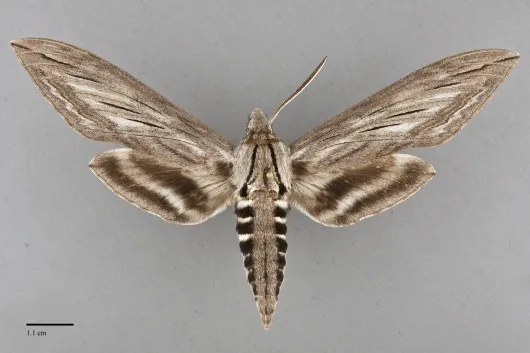
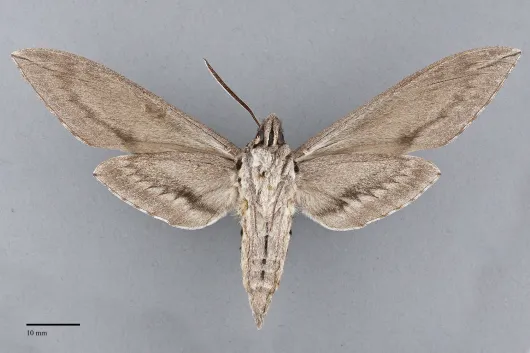
Similar species
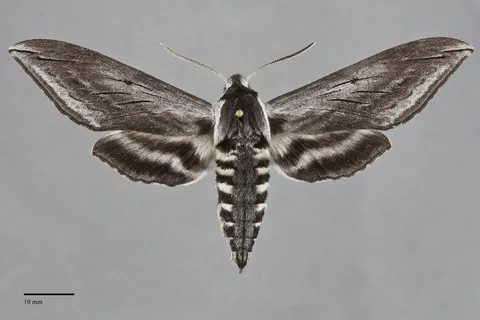
Sphinx chersis is the largest member of genus Sphinx, with forewing length measuring 53–58 mm. The forewing displays an elongated, slender form featuring a pointed apex and weakly concave trailing edge. Coloration consists of streaky light to medium gray tones, palest in the distal subterminal region, alongside six extended black dashes arranged from the lower median area toward the apex. Gray transverse lines appear diffuse and partially incomplete except for the subterminal line. No discal spot is visible. Hindwings are slightly brownish light gray with wide diffuse black bands. The thorax is light gray with black lines at tegulae medial edges. The abdomen exhibits gray dorsal coloring with black and white dorsolateral banding.
This species is distinguished by its large size, light gray coloration with longitudinal black dash markings on forewings, and light gray thorax displaying black tegular lines. The similar Sphinx perelegans is slightly smaller and stouter, with darker fore- and hindwings and a darker thorax. The larva displays blue-green coloring with broad black and white lateral stripes and a caudal horn.
Habitat
This species inhabits low elevation mixed hardwood forests and riparian habitats west of the Cascades, remaining relatively rare in the Willamette Valley but becoming more common in southwestern Oregon.
Distribution
Pacific Northwest records exist from the Willamette Valley region of western Oregon and the Columbia Gorge. Globally, Sphinx chersis is broadly distributed across North America north of Mexico, extending to southern Canada from Nova Scotia to Alberta. The species likely does not inhabit the driest Great Basin portions of the interior Pacific Northwest.
Life History
Primary larval hosts include ashes (Fraxinus spp.) in the Oleaceae and cherries (Prunus spp.) in the Rosaceae. Adults have been collected from April through September in the Pacific Northwest, with peak frequency from May through July. They are nocturnal and attracted to lights and flowers.