Similar species
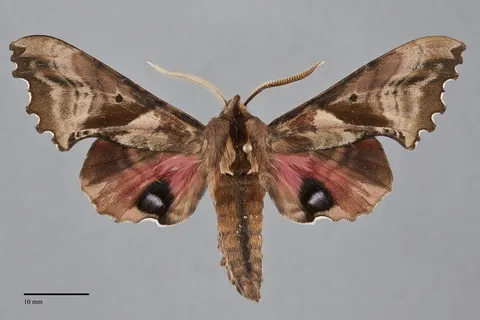
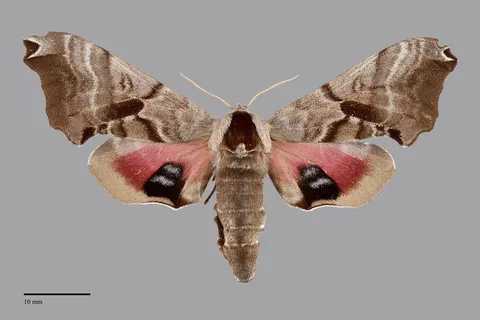
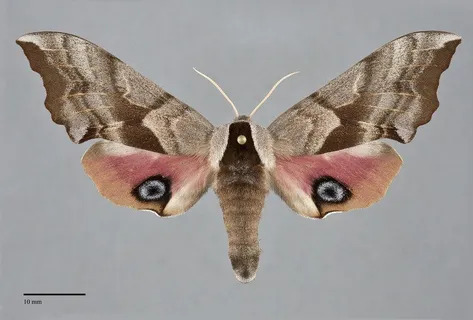
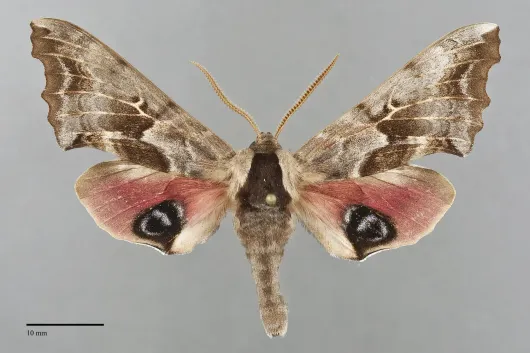
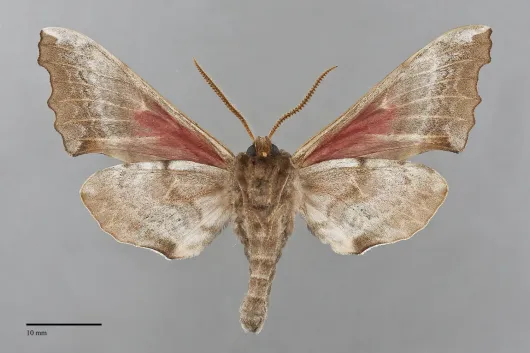
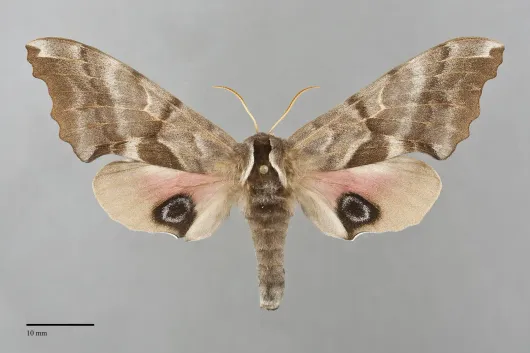
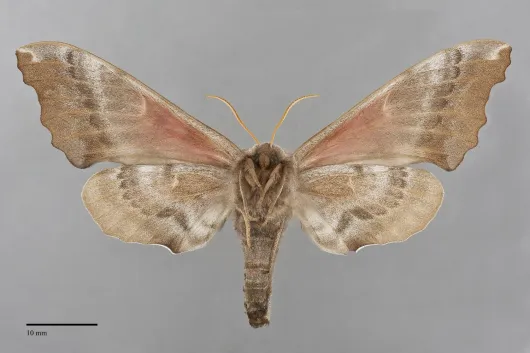
Smerinthus cerisyi is a large to very large moth with forewing length of 29–39 mm. The hindwings display rose-pink coloring with a characteristic blue eyespot featuring a central black pupil. The forewing has a strongly scalloped outer margin with coloring in various shades of gray and darker gray-brown. Key distinguishing features include pale, nearly white cubital veins extending almost to the outer margin, and a powdery white or light blue-gray subterminal line. The head and median collar are brownish gray, while the central thorax is blackish brown.
This species can be distinguished from Smerinthus ophthalmica by having wider antennal pectinations, a more strongly scalloped forewing outer margin, more extensive pale veins, more irregular postmedial lines, and a strongly angled antemedial line. All S. cerisyi specimens are gray, whereas some S. ophthalmica individuals exhibit brown forewings. The larva is granulose green with yellow subdorsal lines and yellow lateral stripes, plus a short caudal horn.
Habitat
This species inhabits boreal forest and aspen parkland ecosystems.
Distribution
Found only in central and northern British Columbia and southern Alberta within the Pacific Northwest region, where it replaces S. ophthalmica. Globally, Smerinthus cerisyi is distributed across the boreal forest zone from Alaska, central Yukon Territory, and Northwest Territories to Newfoundland, extending southward to central Alberta, the western Great Plains, the Great Lakes region, southern Ohio, and Pennsylvania.
Life History
This foodplant specialist feeds on Salicaceae, including willows (Salix spp.), cottonwoods (Populus spp.), and quaking aspen (P. tremuloides). The species is single-brooded with a flight period from May through July in British Columbia. Adults are nocturnal, attracted to lights, and have reduced mouthparts and do not feed.