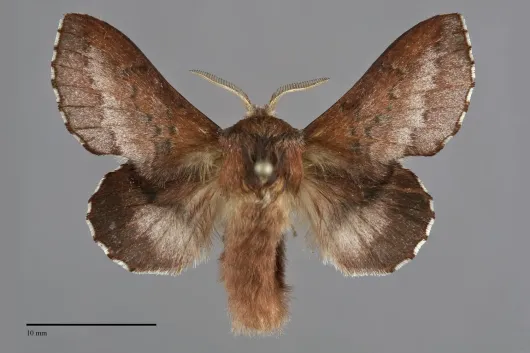
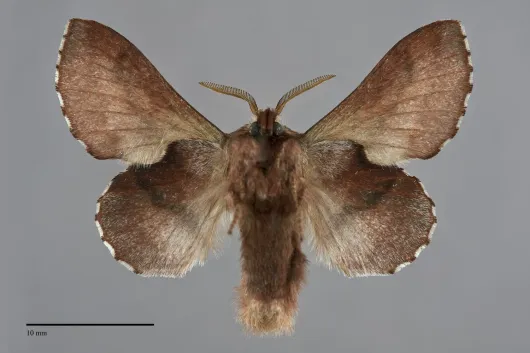
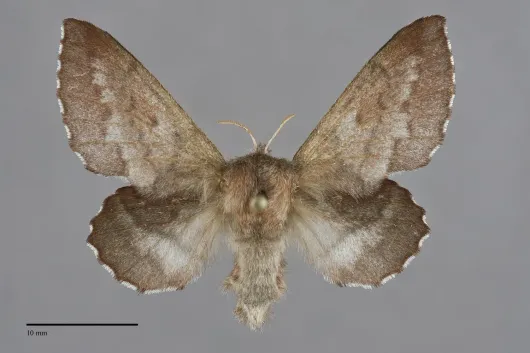
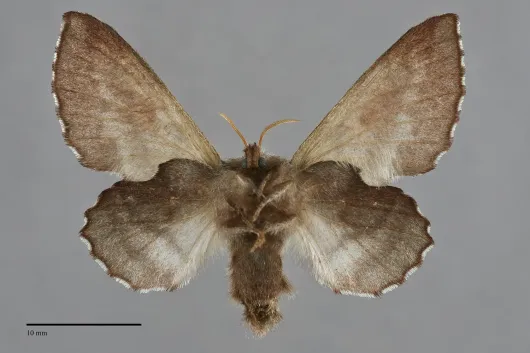
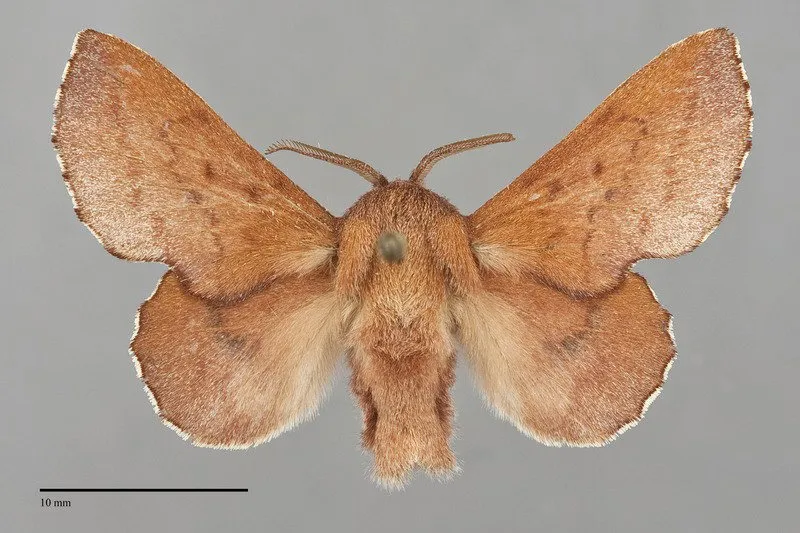
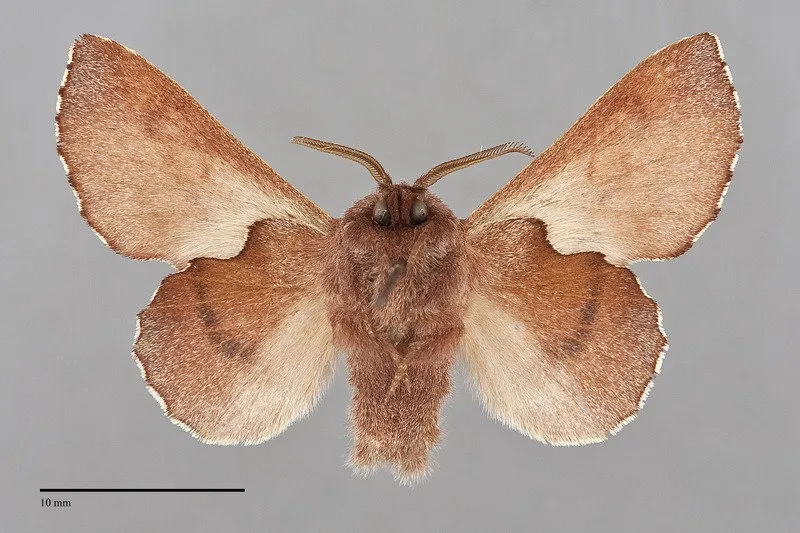
Phyllodesma americana is an abundant red-brown moth that flies throughout most of the Pacific Northwest during spring and early summer. It is medium-sized, with larger females (forewing length 14–17 mm in males; 19–22 mm in females). Its wings have blue-gray shading and their outer margins are weakly scalloped, accentuated by checkering. The forewing posterior margin has a large flange and the anal angle has a deep concave contour unique to the genus. Both fore- and hindwings are bright brick-red with light blue-gray in the cell, the distal subterminal area, and terminal area. The antemedial, postmedial, and subterminal lines are dark gray or red-brown, thick, slightly uneven, and interrupted by the veins. The orbicular and discal spots are dark, similar to the lines in color. The fringe is checkered red-brown and white. The head and thorax are red-brown. The antennae are bipectinate, strongly in males and weakly in females.
This moth is easily identified in most of the region by its red color, scalloped margin, and deeply concave notch at the anal angle of the forewing.
Phyllodesma coturnix Lajonquière was synonymized with Phyllodesma americana in the most recent checklist of North American moths (Pohl & Nanz 2023). This name has been used in the past for some California and southern Oregon populations. Franclemont (1973) and Powell & Opler (2009) separated coturnix from americana only by its smaller size and male genitalia. Limited mtDNA barcode sequence divergence in California material has been read by some as suggesting two taxa.
Habitat
This species is common to abundant in all forests and riparian habitats throughout the Pacific Northwest, occurring at most elevations to near timberline. It is most abundant in moist to moderately dry forests, and is relatively uncommon in very dry juniper woodlands east of the Cascades.
Distribution
Phyllodesma americana is found in forests throughout the region, as far north as northern British Columbia not far south of Yukon Territory. It is least common in arid steppe habitats where it is restricted to riparian areas and scattered aspen groves. Globally, the species occurs throughout most of North America except the Southeast, where it is replaced by Phyllodesma carpinifolia (Boisduval).
Life History
Adults have reduced mouthparts and do not feed. They are strong fliers with a rapid buzzing flight, nocturnal, and readily attracted to lights, although females are less often collected than males. Pacific Northwest records extend from early spring to late August, with most records from late April to early July. Larvae are generalist hardwood feeders recorded on at least 12 genera of trees and shrubs in the families Rosaceae, Salicaceae, Rhamnaceae, Betulaceae, and Fagaceae. The larva has lateral tufts of soft, fuzzy gray hairs with mottled gray and yellow-orange dorsal coloration.