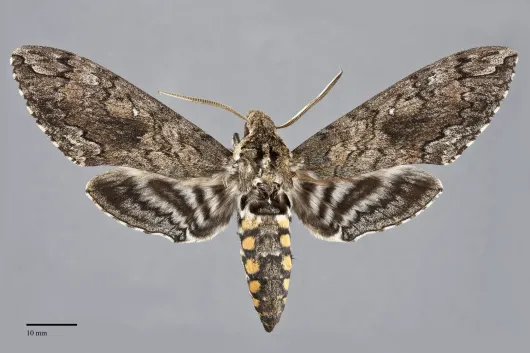
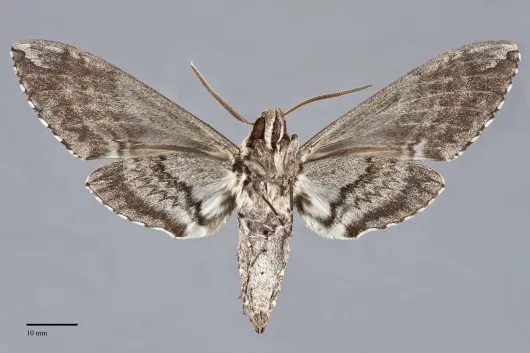
Similar species
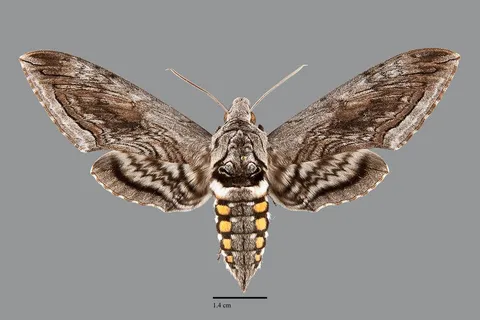
Manduca sexta is an exceptionally large moth with a forewing length of 52–59 mm. The forewing displays mottled gray-brown coloration with a complex pattern of wavy black lines, including a complete black subterminal line. The wing is notably elongated and pointed apically, with a concave posterior margin. A small black discal spot with white center appears in the middle area. The hindwings are lighter, whitish gray with slight bluish tint in some specimens, marked with several black and dark gray bands. The abdomen features bright yellow and black bands on each dorsolateral segment, separated along the midline by a hoary gray stripe.
This species belongs to genus Manduca, identifiable by the yellow and black spots on the dorsal abdomen. Differentiation from the more common Manduca quinquemaculata depends on the forewing subterminal line: wavy and similar to other lines in M. sexta, versus black, nearly straight, and more distinct in M. quinquemaculata. Larvae feed on Solanaceae including tobacco, tomatoes, and potatoes.
Habitat
This species appears to be a long-distance migratory stray rather than an established Pacific Northwest resident.
Distribution
Pacific Northwest records are limited to southeastern Washington and Oregon's Willamette Valley. Globally, Manduca sexta occurs throughout the New World, extending as far south as Chile. Within the United States, it ranges from coast to coast, reaching Nebraska in the Great Plains and Massachusetts on the East Coast. Western distribution is more limited, primarily near the Mexico border and extending to California north of San Francisco.
Life History
Larvae are foodplant specialists feeding on Solanaceae members including tobacco, tomatoes, and potatoes. Pacific Northwest records occur in May and September. The species typically appears in late summer and early fall throughout most of its range. It may damage agricultural crops in the southern United States but has no significance to the Pacific Northwest.