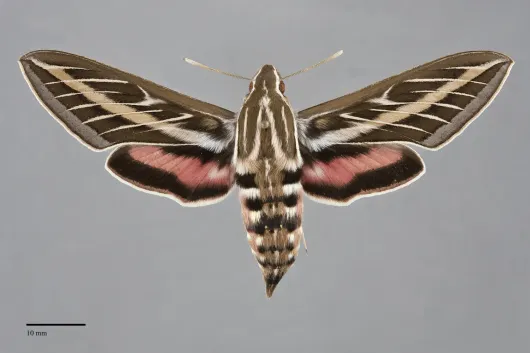
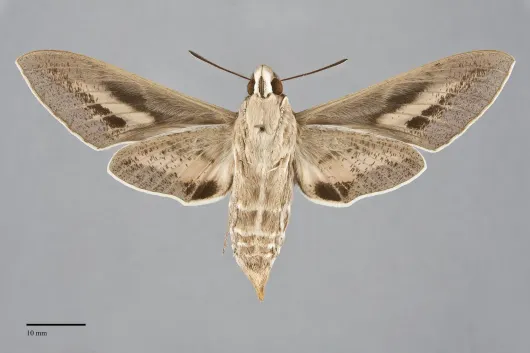
Similar species
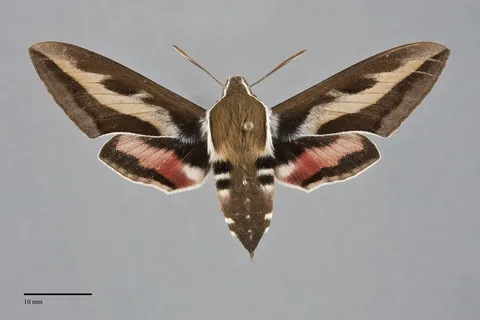
Hyles lineata is a large to very large sphinx moth (forewing length 29–40 mm) commonly observed hovering while feeding at flowers in the evening. The species displays distinctive markings including dark olive-brown forewings with a silver-gray terminal area and an ochre diagonal stripe extending from the posterior wing base to the apex. Forewings showcase prominent creamy white veins and discal spots. The hindwings feature distinctive deep pink and black striping. Head and thorax coloration matches the forewing ground color with white longitudinal streaking on the head and tegulae. The abdomen is brown dorsally with pink lateral coloring and black-and-white dorsolateral striping. The antenna is club-like.
This moth is identifiable by its large size combined with white veins on brown and yellow forewings and pink-and-black hindwings. The species most closely resembles Hyles gallii, which lacks white marks on the thorax and forewing. The larva is polymorphic—black, yellow, or green—with yellow lateral and subdorsal lines and a caudal horn.
Habitat
This species demonstrates broad habitat tolerance, occurring everywhere in the Pacific Northwest at all elevations in all types of habitat including urban areas, low elevation grasslands west of the Cascades, high mountain meadows, and desert rangelands east of the Cascades.
Distribution
Hyles lineata is found throughout the Pacific Northwest north to southern British Columbia. Scattered northern records include Haida Gwaii and the Peace River region, though it is not a regular resident across much of British Columbia. Globally, the species occurs throughout the continental United States except northern Maine, extending from southern Canada to the Mexico border, and is often abundant in the desert Southwest.
Life History
This species is a foodplant specialist within the Onagraceae, particularly favoring fireweed (Epilobium spp.) and evening primroses (Oenothera spp.) in the Pacific Northwest. Adults are predominantly nocturnal but also fly during evening hours, are avid feeders at flowers with long corollas, and are familiar to many as "hummingbird moths." The species has a long flight season spanning late spring through late fall. Larvae may occasionally damage ornamental evening primrose family plants in urban gardens.