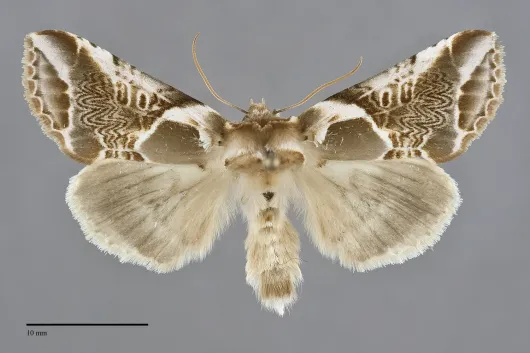
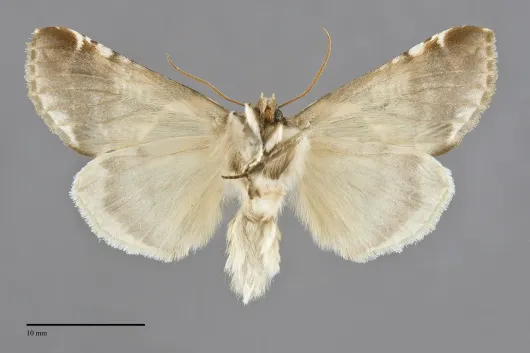
Habrosyne scripta is a distinctive medium-sized moth with forewing length of 17–19 mm that inhabits forests throughout the Pacific Northwest during late spring and summer. The species exhibits a harlequin-like pattern of white on gray and warm brown with a pattern of curves and squiggles. The forewing's outer margin features a scalloped white line at the base of the fringe, and the anal angle is expanded as a small flange.
The pattern includes two white arcs: one along the basal and antemedial lines across the costal margin, and another at the subterminal line near the outer margin. A third white area extends along the costal margin on the mid-wing. The postmedial line comprises five very wavy parallel lines. The hindwing appears pale yellow-gray with darker gray suffusion toward the outer margin. This species is unlikely to be confused with any other species in the Pacific Northwest due to its distinctive warm gray-brown forewing coloration. The larva is smooth and mottled reddish brown.
Habitat
This species thrives in mixed hardwood-conifer forests at low to middle elevations west of the Cascades, including coastal rainforests of the Coast Range and mixed forests along the west slope of the Cascades. It also occurs in mixed hardwood-conifer forests of the Rocky Mountain region and boreal forests further north.
Distribution
Habrosyne scripta is widespread in forests of the Pacific Northwest, including all of western Oregon and Washington, southern and central British Columbia, and in Idaho north of the Snake River Plain. The northern limit appears to be in the Peace River region of British Columbia. It has not been found in eastern Oregon and is only known from the Blue Mountains in southeastern Washington. Globally, the species is widely distributed across boreal forests in northern North America, extending south to Kentucky in the east.
Life History
A foodplant specialist feeding on various Rubus species in the Rosaceae, particularly salmonberry (Rubus spectabilis) in coastal rainforests. The species has a long flight season from late spring until early fall and readily comes to light.