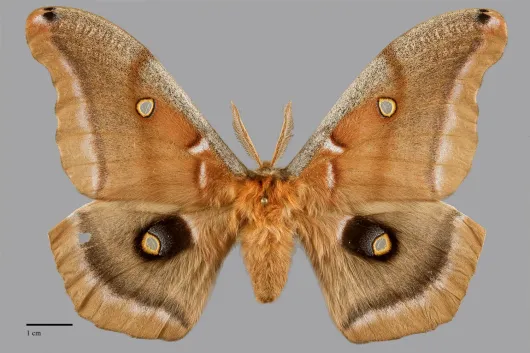
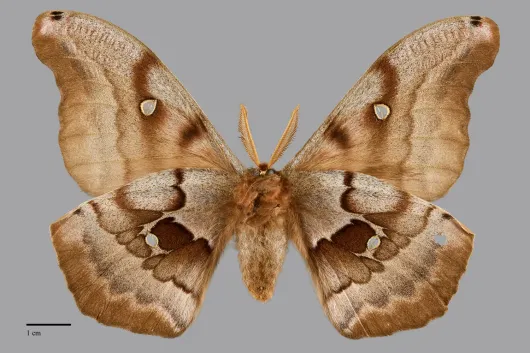
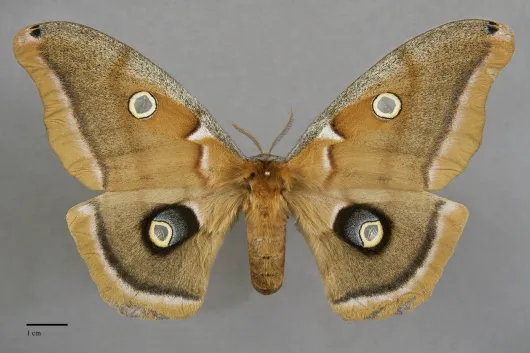
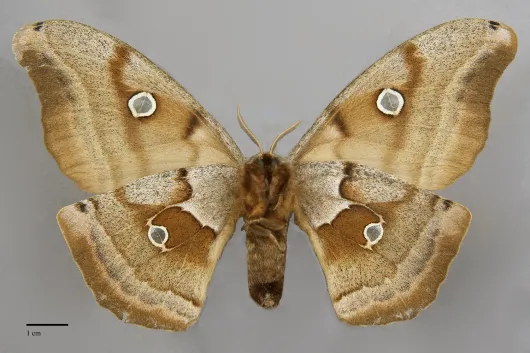
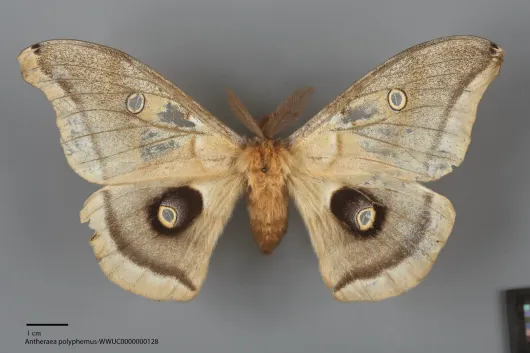
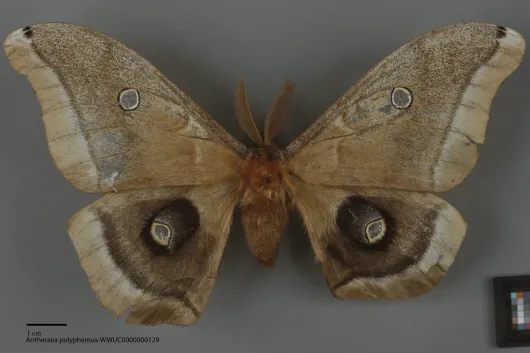
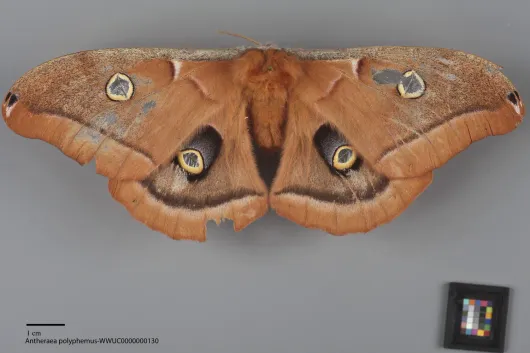
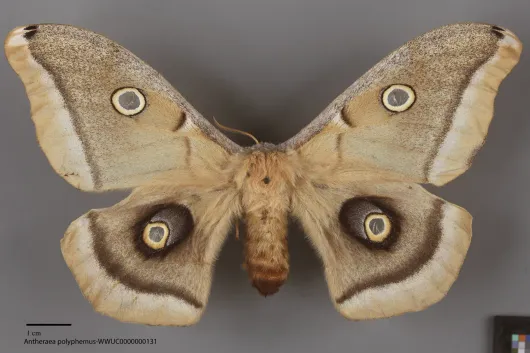
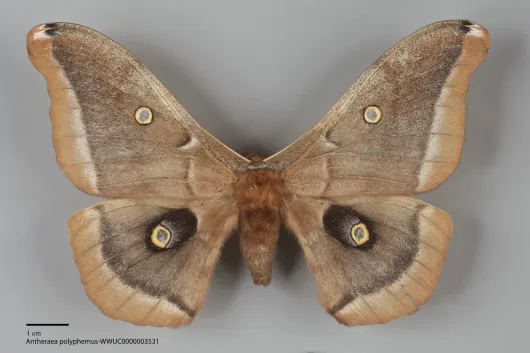
Antheraea polyphemus is a giant moth measuring 44–68 mm in forewing length with a 9.9–16.5 cm wingspan. The wings display buckskin-brown coloring, occasionally with olive or reddish tones, featuring salt-and-pepper light and dark scales near the costal margin. Both wings showcase distinctive eyespots with black and yellow outlines and clear centers. The hindwing eyespot is particularly dramatic, surrounded by jet black and preceded by powdery blue scales.
The species is readily distinguished from other North American moths by its combination of large size, tan coloration, and prominent clear eyespots. Larvae possess a bright green body with red-colored setae bases; the head and true legs are brown, while prolegs display yellow coloring with black tips.
Habitat
This species thrives in wet forested areas, woodlands, deciduous hardwood forests, orchards, and wetlands throughout the Pacific Northwest at low to middle elevations. The moth readily adapts to urbanized and suburban garden environments. Population explosions occasionally occur in commercial hazelnut orchards in western Oregon.
Distribution
Antheraea polyphemus ranges widely throughout the Pacific Northwest, extending north to northeastern British Columbia, but is absent from dry steppe regions including southern Oregon, Idaho, and the Columbia Plateau. Globally, it is found throughout most of North America, occurring in all Canadian provinces except Newfoundland and across most of the continental United States. Western distribution remains patchy. The similar species Antheraea oculea replaces it in southern Arizona and adjacent New Mexico.
Life History
Eggs are laid singly or in groups of 2–3 on host plant leaves. This generalist feeder prefers trees and shrubs in the Aceraceae, Rosaceae, Salicaceae, Betulaceae, and Fagaceae; in western Oregon, big-leaf maple and Oregon white oak are the most common hosts. Silk cocoons hang from twigs throughout winter. Adults are nocturnal and strongly attracted to light, frequently appearing at porch lights. Pacific Northwest populations are typically single-brooded, with records from mid-April through August. Like all Saturniidae, adults do not feed.